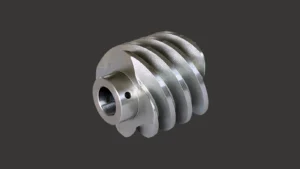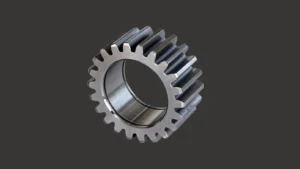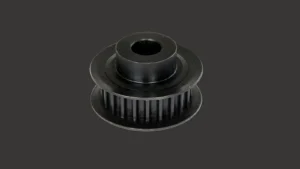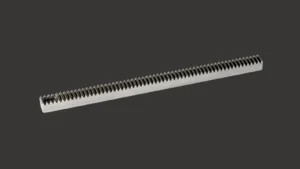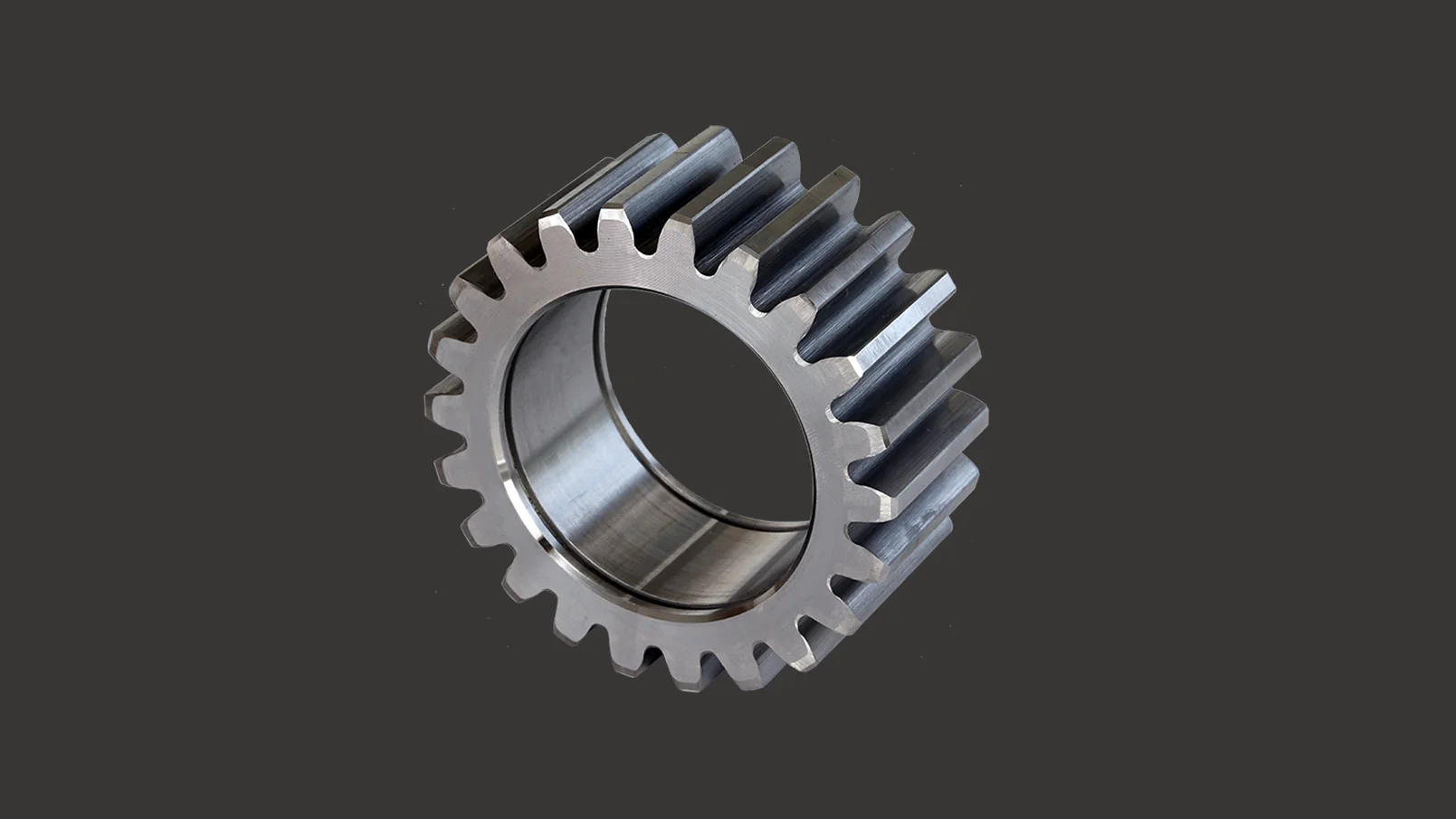
A gear, also known as a spur gear, is characterized by evenly spaced teeth on a rim; when two or more gears work together, they form a gear train.
Machining of spur wheels
Types of Gears
- Crowned
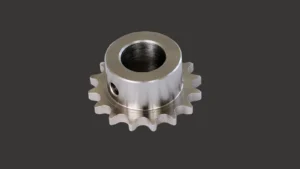
- Straight
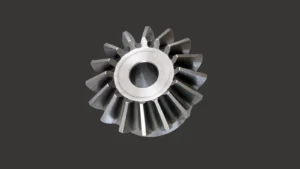
- Conical
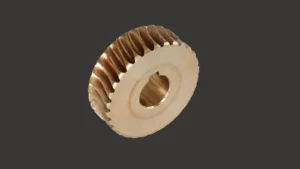
- Helical
Hobbing
- Processing size:
- Max. Ø 400 mm, module 10
Shaping
- Processing size:
- Max. Ø 400 mm, module 10
Peel Gear Cutting
- Processing size:
- Max. Ø 400 mm, module 10
Tooth flank grinding
- Processing size:
- Max. Ø 400 mm, module 10
Gear wheel
A gear is a machine component on which a specific number of teeth are evenly distributed around the circumference. When a gear is connected to one or more other gears, it forms a gear train, which provides the drive mechanism for systems such as cable cars or mill wheels. The shape of the teeth can be arbitrary, but all the teeth in a gear train must have the same shape in order to mesh with one another. It also does not matter whether a gear has helical or straight teeth, as long as it meshes with its mating gear.
Spur gears and other types of gears
Gears have a long history and have thus evolved in a variety of ways over time. The earliest forms of gears date back to ancient Egypt. While these early versions were made entirely of wood, today this machine component can be manufactured from a wide variety of non-ferrous metals (steel, stainless steel, aluminum, etc.) and in a wide range of designs. Anyone looking to buy gears can therefore choose from a wide range of products offered by various gear manufacturers.
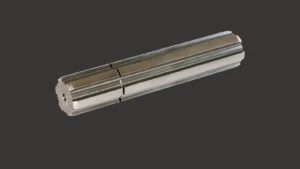
The most commonly produced and used type is the spur gear. Since the disk, which is toothed along its circumference, is cylindrical, it is also referred to as a cylindrical gear or simply a gear, as it represents the most basic form of gears. A characteristic feature in this case is that the gear is toothed on its outer surface. In contrast, internally toothed gears are not referred to as spur gears. As soon as a spur gear is paired with a mating gear—such as another spur gear or a spur-toothed shaft—a spur gear train is formed. The teeth can be straight, helical, bevel, or spherical. However, if a gear has helical teeth, it runs more smoothly and quietly overall than the straight-toothed version. This is because helical teeth transmit torque particularly evenly.
Other types of gears include, for example, racks, bevel gears, worm gears, crown gears, and elliptical gears. They all operate on the same principle of evenly spaced teeth and generate drive when combined with a spur gear. In a rack-and-pinion drive, although the rack is not wheel-shaped, it still has the same effect, since in this case the rack can be imagined as a wheel with an infinitely large diameter. However, the resulting rotational motion is linear, which is why rack-and-pinion drives are particularly favored in mountain rail technology, for example, in cog railways. The rack functions as a toothed rail that runs parallel to the track rails. Another special feature is the elliptical gear, in which the gear is not round but elliptical in shape. As a result, the driven gear—unlike in the round version—does not rotate uniformly.
Gear Manufacturing
Gears can be manufactured using die-forging, forming, free-form milling, or machining. At Ringhoffer, we focus on machining in gear production because the machine components produced this way are highly durable and much more precise than, for example, die-forged variants. High precision is important, among other things, when quiet operation is essential.
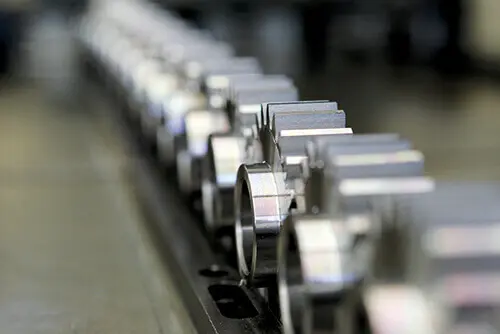
Of the various machining processes, we use gear hobbing, gear shaping, and gear grinding ingear manufacturing. The module, material diameter, and resulting quality vary depending on the machining method. For example, the maximum diameter is 600 mm when a gear is to be milled (module 10). This process achieves quality grade 7. In contrast, for both gear hobbing and gear flank grinding, the diameter must be smaller than for gear hobbing: The material can have a maximum diameter of 400 mm for gear production by grinding (module 8, quality level 5) and 500 mm for production by gear hobbing (module 6, quality level 7).
In the field of gear manufacturing, there are a total of 12 quality grades, which are specified by DIN 3961. Grade 1 represents the finest gear quality, and grade 12 represents the coarsest. Additional tolerances for gears are defined in DIN 3962.
Top Quality from Ringhoffer
In our production facilities, equipped with modern CNC milling machines, our highly qualified manufacturing team produces gears in various sizes and with different types of tooth profiles. The result is top-quality products—whether milled, rolled, or ground—that are highly durable, precise, and long-lasting. Ringhoffer prioritizes the highest quality in both the materials used and the gear manufacturing process itself to prevent tooth breakage, pitting, wear, or other damage that can occur in this machine component. That’s why Ringhoffer, as one of the top gear manufacturers, is the perfect choice for anyone looking to purchase gears.